
How to Become Trustworthy
The no‑BS math behind the money, respect, and opportunities you miss

Before we start: this essay was sparked by Max Meursault’s piece on The Game Theory of Social Trust. Short, sharp and worth reading first. The cycle he maps:
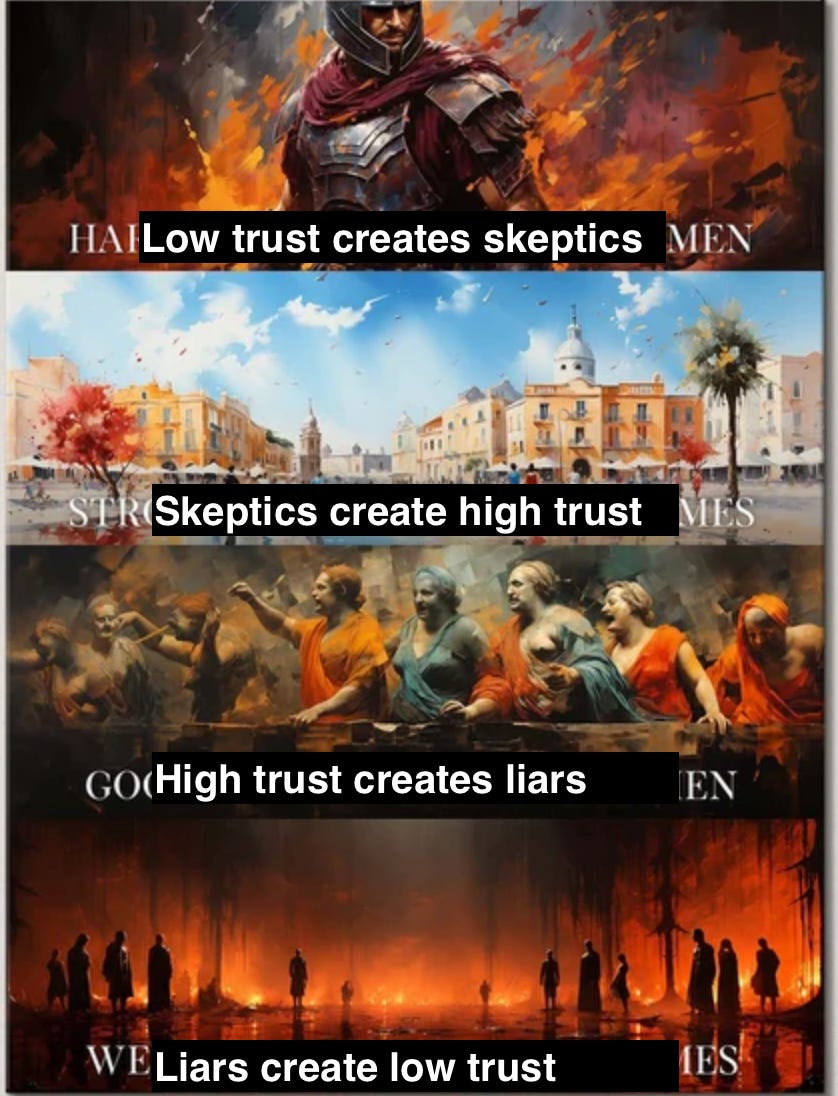
In trying to answer the questions he raised, I went further upstream. What actually generates the trust in the first place?
In this essay, you will understand:
Why your detailed Iron Man drawing gets 3 likes on Facebook while someone sells a dot that looks like dog poop for $2 million
Why the cold DM closes less than you think, and what actually works
How to get the girl, get the governor to know you, get the deal — using the same mechanism
Why Rome fell, why some currencies keep dying, and what either has to do with your career
How MrBeast became the biggest creator on earth
Everything you have received from another human being was a function of what they believed it would cost them to lose you. It runs underneath every transaction, every relationship, every civilisation. Once you see it, you cannot unsee it.
Forty Thousand Years of Flex
Forty thousand years before the blockchain, a hunter drilled a hole through a mammoth ivory bead and wore it around his neck.
It was a status signal. How did he figure out it was worth doing at all?
Status is the social ledger of demonstrated cost. The bead communicates something and proves it at the same time: I hunted the mammoth. I killed it. I had surplus energy afterwards to spend on this. A weak, starving person cannot fake a mammoth ivory bead any more than a broke person can fake a Mayfair address. The cost of production is the proof of capability. Capability, demonstrated visibly and repeatedly, is what makes a group defer to you, follow you, trust their resources and children and lives to your decisions.
Status is the social mechanism for routing trust toward the people whose track record makes defecting against them irrational. Trust is downstream of status. Status is downstream of demonstrated costly signal. The bead was the beginning of all three.
It is identical to Jay‑Z’s Roc‑A‑Fella chain and to Bitcoin’s proof‑of‑work. The bead and the blockchain are the same invention. Both store trust in the irreversible cost of production. Both derive their credibility from the physical fact that counterfeiting them requires the same expenditure as creating them.
Trustworthiness ∝ (Irreversible Cost Already Paid) / (Potential Gain from Defection)
When what you stand to lose exceeds what you could steal, you are trustworthy. Because betrayal becomes more expensive than cooperation, and rational agents do not light money on fire. A murderer can be trusted to murder. A corporation can be trusted to exploit. A politician with nothing to lose can be trusted to take everything.
Every piece of advice about “building trust” that focuses on character instead of mechanism is decorative at best and dangerous at worst.
The mechanism does not care what you intend. It reads only what you have already burned.
The Machine Gets Bigger
Money evolves as a trust mechanism based on irreversible cost.
In small tribes, reputation stored trust; betrayal meant exile or death. As groups grew, gold became the ledger: heavy, costly to produce, impossible to fake without burning the same energy as production.
Coins added state certification. Paper money replaced gold, backed by institutional solvency until Nixon ended convertibility in 1971, leaving fiat backed only by government credibility.
When betraying the ledger carries little consequence, the ledger fails. Argentina’s peso has lost roughly 99% of its value against the dollar since the 1980s.
Bitcoin is a return to the original mechanism: trust stored in thermodynamic cost — energy burned to create each block that cannot be faked, reversed, or reprinted.
The people who don’t understand why Bitcoin has value are the people who don’t understand why the mammoth bead had value.1
Why MrBeast Didn’t Chase Money
MrBeast does not spend $2 million on a video because he is generous. He spends it because the video itself becomes a hostage. The sunk cost is so immense that defecting against his audience — delivering low quality, faking a giveaway, betraying trust — would destroy more value than any short‑term gain from cheating.
But he did not start with money. He started with time. In 2016, he filmed himself counting to 10,000 for fifty retweets someone had promised him. The year after, he filmed himself counting to 100,000 — forty hours, on camera, alone in his room, for nothing. No sponsor. No crew. No guarantee. Just visible, irreversible expenditure of time that no rational person would fake, because the cost of faking it equalled the cost of doing it.
The money came after. And when it did, he burned that too. Every Squid Game recreation, every private island giveaway, every 50‑hour survival challenge is a mammoth bead. Each one makes defection against his audience more irrational than the last. His billions of views are the arithmetic of irreversibility applied to entertainment.
He is not trusted because he is likeable — though he is. He is trusted because the cost of faking his level of commitment is indistinguishable from actually having it.
The Monument, Not Just the Cost
It is not enough to burn cost. The cost has to produce something others cannot easily replicate. Cutting grass with scissors is a high‑cost activity. Nobody trusts you more for it because anyone could do it (easier with a lawnmower) and the output has no value. The irreversibility has to be attached to a monument — something that stands as proof no shortcut could have produced it.
No one can dance like Michael Jackson. That permanent gap between his output and what anyone else could produce is why he signalled permanent high trust and permanent high value. The moment something becomes easily copied, it ceases to signal anything. High trust that is cheap to signal creates liars.
Trust is rewarded to those who would do the thing regardless of the reward. You tend to have a better reputation when you are indifferent about what your reputation is. That indifference is itself an unforgeable signal — the work shows whether you care about the thing or about being seen caring about it.
Dead Capital
In Egypt, in Peru, in Haiti, in the Philippines — the poor own real assets. Land. Homes. Businesses. They cannot leverage a dollar of any of it. The trust architecture that would make them flow does not exist. No title deed. No legal record. No enforceable claim. The asset lives in the physical world but not in the ledger that civilisation actually runs on. Hernando de Soto called this dead capital. He measured $9.3 trillion of it sitting frozen across the developing world right now.
This does not only apply to countries.
Your skills are real. Your intelligence is real. Your ideas have genuine value. If none of it has a public, permanent, legible record — if there is no archive that makes your irreversibility visible to strangers who don’t yet know you — then all of it is dead capital. Present and inaccessible.
The difference between you and the person who seems less capable but receives more is almost never the assets. It is the ledger. Theirs is public. Yours is private. The mechanism routes capital toward legible ledgers. It cannot read you if it cannot see you.
Why Good Work Goes Unnoticed
In a world where faking sunk cost has become industrialised — rented mansions filmed from fifty angles, deepfake faces by the hour, fake six‑month relationships recycled across hundreds of victims simultaneously — the mechanism has a problem. It cannot distinguish invisible real work from invisible fake work. Both return the same answer: nothing visible.
This is why your sincere, ambitious effort does not automatically get trusted. The mechanism is not unjust. It is just unable to read you. The only defence is making your work legible — public, permanent, too expensive to have been produced without genuine obsession.
Theranos was the high‑status version of the same faking. Borrowed trust has no floor. When it collapses, it collapses instantly.
Trust Is Farmed
You trade with trust, but trust is not traded. Trust is farmed.
Some things you can win or lose in hours. Money. A negotiation. Trader’s games — high intensity, short timescale, outcome in a session.
Some things you cannot move in hours no matter what you do. Your health. Fluency in Japanese. Chess grandmaster. Reputation. Farmer’s games — low intensity, long timescale, daily accumulation, harvest much later.
The catastrophic error is applying a trader’s logic to a farmer’s crop. Front‑loading fifty‑seven hours into one position, watching it not pay immediately, concluding the mechanism is broken. The mechanism was not broken. The timescale was wrong.
A little of the important things, every day you can tolerate, alongside everything else. Fifteen minutes of Japanese vocabulary — the minutes you would have spent waiting anyway. One chess position. One paragraph of public writing. One small bet on a risky project. These minutes don’t compound to fifty‑seven hours of pain. They compound to fluency, to pattern recognition, to a body of work — and if any single day fails, the downside is fifteen minutes.
You do not spend ten hours on a cupcake label that will be seen for one second and thrown away by twenty‑six people at your kid’s birthday party.
You do spend seven years on a book that will be read by millions for decades. Sunk cost is rational when the reach and lifespan of the output justify it.
Consistency is not your problem. You already brush your teeth every day. You already scroll social media every day. Reverse engineer why you do those daily without discipline: they’re frictionless, low‑cost to start, and missing a day carries no catastrophic penalty. The streak is not the point. You continue when you can. The crop cares about accumulated water.
This is how I learned to sing crapa pelada (useless, I know, but enjoyed), bring my chess rating up, get conversational in Japanese, and keep risky long‑term projects alive — through the daily minimum, without the catastrophic downside of the all‑in front‑load. (And if those fifteen minutes were “wasted”, the compound of wasted minutes day after day is no different from time you’d have spent on God‑knows‑what anyway. It fades. A whole week of intense effort with nothing else, by contrast, leaves a scar when it fails.)
There is a time to grind: deadline, in the zone, trade demands intensity. Trader’s game, play it fully. But most things that determine the quality of your life in ten years are farmer’s games — and those you play a little every day, not as discipline, but as metabolism.2
There are Two Types of Zeros
Confusing these zeros ends careers, companies, and countries.
The first is interim. Bank account hits zero — refill it. Food runs out — buy more. Battery dies — charge it. 0ᵢ + A = A
The second is terminal. Death. Permanent exile. The reputational destruction that cannot be rebranded away. Losing a leg. 0ₜ + A = 0ₜ . You cannot compound from inside a black hole.
The architecture of becoming valuable requires taking asymmetric bets that risk interim zero exposure, and maintaining total separation from terminal zero. This is the Kelly Criterion. Size every position such that losing does not end the game. Large upside, survivable downside.
Every successful scam in history worked by disguising terminal zero for the victim as interim zero, while ensuring the operator faced only interim zero themselves. The victim could not recover the burned time. The scammer rebrands by Tuesday. The entire architecture of civilisation’s moral machinery exists to make this asymmetry impossible. Where it fails, defection is rational. Where defection is rational, cooperation collapses. Where cooperation collapses, you get what low‑trust looks like from the inside: not evil. Arithmetic.
Money Is for Strangers
Money is the universal medium for people who don’t know each other. Trust is the medium for the elite.
You were fed for years as a child without making a dollar. When you build a website for a restaurant in exchange for meals, no money changes hands. When you do a favour for a powerful person and they remember it years later, no money changes hands. When you get access to a room, a connection, an opportunity because someone vouches for you — no money changes hands. These transactions are frictionless, taxless, and they compound.
Money exists to solve one specific problem: the coincidence of wants. If I have cows and want pigeons, but you have pigeons and want iron, we cannot trade directly. Money solves this by letting us trade across time and mismatched needs. That is what makes it useful. It is also what makes it expensive — every dollar transaction carries fees, taxes, middlemen, verification costs — all of which exist because the parties don’t trust each other enough to transact directly.
High trust is nearly frictionless. A phone call closes a deal that would take a stranger six months of due diligence. A handshake moves capital that a contract couldn’t secure in a year. Money is a proxy for trust; don’t use it when you can trade with the real thing.
On pricing: The present value of any product is the discounted value of all its future expected returns to the customer. A $300 chair that lasts twenty years costs $15 a year. A $100 chair that breaks in two costs $50 a year. The expensive chair is three times cheaper. Price is a signal. When you charge $497 for something worth $50,000 in downstream returns to the right buyer, you are undercharging and undersignalling simultaneously.
Conclusion
Attention is the reserve currency of life. Money is downstream of trust, which is downstream of attention, which is downstream of the archive that burned enough of your time to make other people’s burned time feel safe. Attention is earned through novelty, utility, and truth.
Every collapsed civilisation was a spreadsheet where the sunk cost column was faked.
The mechanism does not have ideology. It only has the equation. When the cost of lying drops below the cost of truth, the equilibrium shifts.
The only available response, as an individual inside an environment where the large ledgers are being corrupted, is to build a small one that cannot be. Personal. Public. Accumulated over time. Stored in honest work, compounding in plain sight, until what you have built costs more to destroy than anything you could gain from destroying it.
This is what the mammoth bead was. This is what gold was. This is what Bitcoin is trying to be.
What are you building that cannot be taken back?
Thermodynamics is not bulletproof. If block production costs drop dramatically — cheap energy, quantum advantage — the unforgeable costliness degrades. Taleb has also argued Bitcoin carries an absorbing barrier: unlike gold, which has industrial value below which price cannot fall, Bitcoin’s floor is terminal zero. He may be right. This is not a Bitcoin essay
Life hack: Pick up a hobby you genuinely enjoy, one you’ll need later to network or get something done. When the time comes, you can’t learn it overnight. Being able to do it signals a cost that makes people trust you immediately. You cannot fake fluency in someone’s language, a difficult dance, or a black belt in Brazilian Jiu‑Jitsu.
Thank you, I really appreciate this! I will use this as a sort of framework for building credibility in a field of electrical engineering I’m quite passionate about